Generative AI for Manufacturing: Transforming Operations, Productivity & Decision-Making
Introduction: Bringing Generative AI to the Manufacturing Floor
Manufacturing is entering a new phase of digital transformation. Artificial Intelligence is no longer limited to futuristic concepts or large technology companies — it is increasingly becoming a practical business tool for manufacturers looking to improve productivity, quality, operational efficiency, and decision-making.
From production planning and quality management to maintenance, supply chain, workforce productivity, documentation, and reporting, Generative AI can help manufacturing professionals reduce repetitive work and make better use of operational data.
However, the real opportunity is not simply using AI tools. The greater opportunity lies in understanding how AI can be applied to real manufacturing workflows.
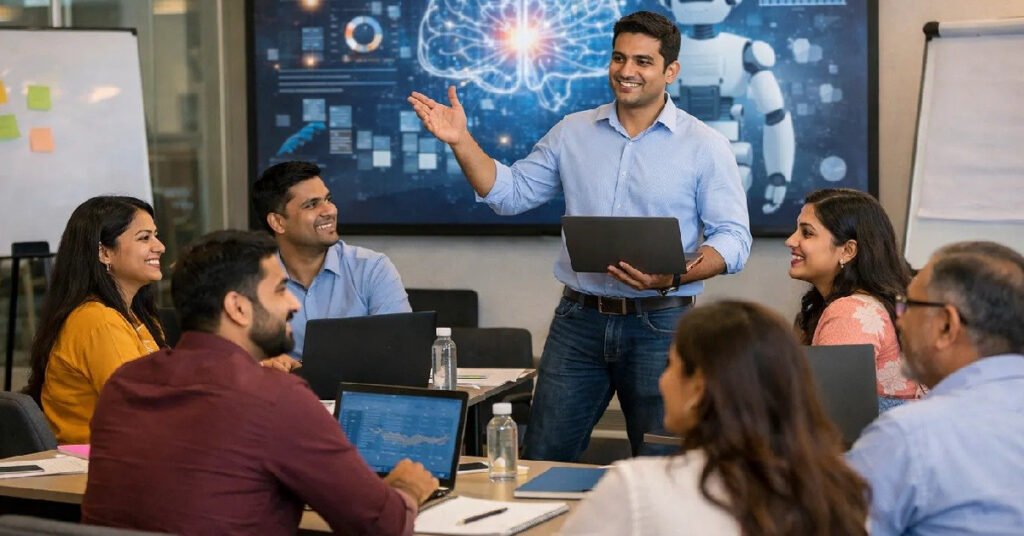
This is the objective of Aarvi Learning Solutions’ “Gen AI for Manufacturing” two-day workshop — a hands-on learning experience designed to help manufacturing professionals move from understanding AI to applying it in their day-to-day operations.
Industry Overview: Manufacturing Meets the AI Era
The manufacturing industry is already moving toward smart manufacturing, connected operations, Industrial IoT, advanced analytics, automation, and AI-powered decision-making.
Generative AI adds another layer to this transformation. Unlike traditional automation, which typically follows predefined rules, Gen AI can understand natural-language instructions, analyse information, generate documentation, summarise complex data, support problem-solving, and assist employees in completing knowledge-intensive tasks.
According to Deloitte’s 2025 Smart Manufacturing Survey, 24% of surveyed manufacturers had deployed Generative AI at the facility or network level, while another 38% were piloting GenAI. The same research found that 29% were using AI/ML at facility or network level.
This indicates an important shift: manufacturers are moving beyond asking whether AI is relevant and increasingly asking where AI can deliver measurable operational value.
GenAI can support areas such as:
- Production planning and scheduling
- Quality management and root-cause analysis
- SOP and technical documentation
- Maintenance request management
- Inventory and supply-chain analysis
- Shift handovers and workforce communication
- Management reporting
- Training and knowledge management
- Operational problem-solving
- Process automation and AI agents
The next competitive advantage may therefore come not simply from having AI technology, but from having employees who know how to apply it effectively.
Explore what's possible with Aarvi GenAI
From AI-powered workflows to smarter operations, transform manufacturing with the power of Generative AI.
Key Statistics & Market Trends
The adoption of AI in manufacturing is accelerating, but the industry is still in a transition from experimentation to implementation.
Deloitte’s research highlights that 38% of manufacturers were piloting Generative AI, while 24% had deployed it at the facility or network level. It also found that manufacturers are prioritising foundational technologies, with 40% investing in data analytics, 29% in cloud computing, 29% in AI, and 27% in Industrial IoT over the following two years.
Another Deloitte analysis found that 87% of respondents in its Future of Manufacturing study had initiated a GenAI pilot, while 24% had adopted GenAI use cases in at least one facility and 10% had implemented it across broader networks.
These numbers reveal a clear trend: AI experimentation is increasing, but scalable implementation requires skills, data readiness, leadership alignment, and well-defined business use cases.
The trend is also moving toward agentic AI and intelligent workflows. Instead of using AI only to generate text or answer questions, organisations are beginning to explore AI systems that can connect information, trigger workflows, summarise events, communicate with users, and support operational decisions.
This is where manufacturing professionals need to develop practical AI capability.
The Major Challenges in AI Adoption
Despite the potential, implementing AI in manufacturing is not without challenges.
1. Lack of practical AI skills
Many employees have heard of Generative AI but do not know how to apply it to their specific roles. Knowing how to ask an AI tool a question is very different from designing a prompt for root-cause analysis, an SOP, production reporting, or quality documentation.
2. Data and knowledge fragmentation
Manufacturing knowledge often exists across Excel files, SOPs, PDFs, maintenance records, reports, emails, manuals, and individual employee experience. Bringing this knowledge together in an AI-ready format is a major challenge.
3. Integration with existing systems
AI cannot operate effectively in isolation. Manufacturers may need to connect AI with ERP, MES, quality systems, maintenance systems, spreadsheets, databases, and other operational platforms.
4. Trust, accuracy and security
Manufacturing decisions can have significant operational consequences. AI-generated information therefore needs appropriate validation, governance, access controls, and human oversight.
Deloitte reports that 65% of survey respondents ranked operational risk among their top two priorities for mitigation when pursuing smart manufacturing initiatives.
5. Moving beyond experimentation
Many organisations conduct AI pilots but struggle to turn successful experiments into repeatable business processes.
The real challenge is therefore not simply “How do we use AI?” but “How do we use AI responsibly and consistently to improve manufacturing performance?”
What Makes the Program Different?
The Gen AI for Manufacturing workshop is designed around practical manufacturing applications rather than generic AI awareness.
The two-day program follows a progression:
Understand AI → Apply AI → Automate Workflows → Build AI Assistants → Create Manufacturing Solutions
Day 1: AI for Productivity & Operational Excellence
Participants learn how Generative AI can improve everyday productivity and operational communication.
The workshop covers:
- Manufacturing-focused prompt engineering
- SOP and work-instruction creation
- Incident and audit documentation
- Production and quality reporting
- Root-cause analysis
- CAPA documentation
- Lean and Six Sigma applications
- Knowledge management
- AI-powered presentations and visual reporting
Tools such as ChatGPT, Gemini, Claude, Perplexity, NotebookLM, Gamma AI and Canva AI are introduced through relevant business applications.
Day 2: AI Automation & Smart Manufacturing
The second day moves from individual productivity toward intelligent workflows.
Participants explore:
- Production planning and scheduling
- Inventory and supply-chain optimisation
- Workforce and shopfloor productivity
- AI-powered operational assistants
- AI agents
- Workflow automation
- RAG and manufacturing knowledge systems
- AI-powered process automation
The program concludes with a capstone exercise — “My AI Manufacturing Assistant” — where participants design a practical AI solution using multiple tools to address a manufacturing workflow.
This hands-on approach makes the program particularly relevant for professionals who want to apply AI rather than simply learn about AI.
Business Impact: From AI Skills to Operational Value
The ultimate objective of AI training should not be the number of tools employees learn. It should be the business impact those tools create.
A well-designed AI capability-building program can help organisations:
Improve productivity: Reduce time spent on repetitive documentation, reporting, summarisation, and communication.
Improve decision-making: Convert operational information into structured insights, recommendations, and action plans.
Strengthen quality management: Support root-cause analysis, CAPA documentation, continuous improvement, and quality reporting.
Improve knowledge accessibility: Make SOPs, manuals, technical documentation, and organisational knowledge easier to access and use.
Accelerate communication: Improve shift handovers, meeting summaries, action tracking, and management reporting.
Enable automation: Connect AI with workflow automation platforms to reduce manual intervention in repetitive processes.
Build future-ready employees: Develop AI fluency among managers, engineers, operations professionals, quality teams, supply-chain teams, and other manufacturing functions.
Most importantly, the program encourages participants to identify specific AI opportunities within their own organisation, creating a bridge between training and implementation.
Why Aarvi Learning Solutions?
Aarvi Learning Solutions brings a practical, business-focused approach to organisational learning and capability development.
Aarvi describes itself as a corporate L&D partner focused on improving workplace productivity and organisational performance, with solutions spanning leadership, behavioural skills, functional and domain capabilities, and IT/technical training.
Its learning approach emphasises client consultation, programme curation, practical delivery, and assessing learning effectiveness rather than relying on a one-size-fits-all training model.
For a rapidly evolving subject such as Generative AI, this approach is particularly important. Manufacturing organisations have different processes, technologies, workforce structures, and operational priorities. AI training should therefore connect with the organisation’s actual business challenges.
The Gen AI for Manufacturing program combines AI tools, manufacturing use cases, prompt engineering, automation, agentic workflows, knowledge systems, and practical exercises to help participants understand how AI can become part of everyday work.
Conclusion
Generative AI is creating a new opportunity for the manufacturing industry — not by replacing manufacturing expertise, but by augmenting the people who possess it.
The future manufacturing workforce will increasingly need to combine domain knowledge with AI capability. Engineers, plant managers, quality professionals, supply-chain teams, maintenance teams, supervisors, and business leaders will need to understand how AI can help them analyse information, solve problems, automate repetitive processes, and make faster and better-informed decisions.
The Gen AI for Manufacturing workshop by Aarvi Learning Solutions is designed to support this transition.
Across two intensive days, participants move from AI fundamentals and productivity applications to automation, AI assistants, agentic workflows, RAG, and practical manufacturing solutions.
The goal is simple:
Don’t just learn what Generative AI can do. Learn how to make it work for your manufacturing operations.
With the right skills, use cases, governance, and implementation mindset, Generative AI can become more than another technology initiative — it can become a practical enabler of productivity, operational excellence, innovation, and smarter decision-making.