How the Everest Challenger Team Building Program Strengthened Leadership, Collaboration, and Problem-Solving Capabilities for Middle Management
Client Overview :
In today’s rapidly evolving business environment, organizations require leaders who can navigate uncertainty, collaborate across functions, solve complex challenges, and inspire teams to achieve ambitious goals. While technical expertise and operational knowledge remain important, success increasingly depends on leadership capabilities, teamwork, adaptability, and strategic thinking.
A leading ESG organization approached Aarvi Learning Solutions with a specific leadership development objective. The company wanted to strengthen the teamwork, collaboration, planning, and problem-solving capabilities of its middle management team.
The participants were responsible for managing teams, coordinating across departments, driving business performance, and translating organizational strategy into execution. As the organization continued to grow, leadership recognized the importance of developing managers who could work effectively in uncertain situations while maintaining strong collaboration and decision-making capabilities.
To address these objectives, Aarvi Learning Solutions designed and delivered an experiential offsite team-building intervention using the highly engaging Everest Challenger Simulation.
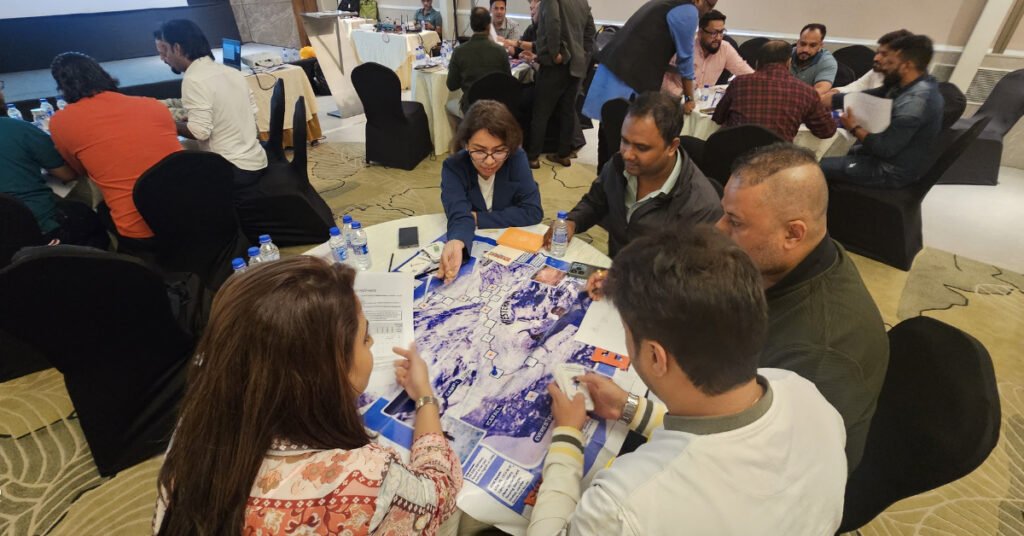
The program brought together 40–45 middle managers in a physical workshop environment where participants experienced the challenges of planning and executing a virtual expedition to Mount Everest. Through this immersive simulation, participants developed critical workplace skills such as strategic planning, negotiation, collaboration, leadership, critical thinking, and decision-making under pressure.
The objective was not simply to conduct a team-building event. The goal was to create meaningful behavioral learning that participants could immediately apply within their workplace.
The Business Challenge :
Organizations today operate in increasingly volatile, uncertain, complex, and ambiguous (VUCA) environments. Leaders are expected to make decisions quickly, manage competing priorities, collaborate with multiple stakeholders, and drive results despite uncertainty.
The client identified several challenges commonly faced by middle managers:
- Working effectively across functions and departments.
- Aligning team goals with organizational objectives.
- Managing competing priorities.
- Making decisions under uncertainty.
- Building collaboration among diverse teams.
- Developing strategic thinking capabilities.
- Strengthening problem-solving skills.
- Enhancing leadership effectiveness.
Although participants possessed strong professional and functional expertise, leadership recognized the need to strengthen their ability to operate successfully in dynamic business environments.
The organization wanted managers to experience firsthand how planning, communication, collaboration, and decision-making influence team success.
Rather than using traditional classroom-based training, the client sought a highly engaging experiential learning solution that would challenge participants to think strategically, work together, and learn through experience.
Why Design Thinking for Team Building and Leadership Development?
Modern leadership requires more than authority and technical expertise. Effective leaders must understand people, solve problems creatively, adapt to changing circumstances, and make decisions that balance multiple perspectives.
Design Thinking provides a powerful framework for developing these capabilities.
The principles of Design Thinking encourage participants to:
- Understand stakeholder perspectives.
- Navigate ambiguity.
- Explore multiple solutions.
- Collaborate effectively.
- Test assumptions.
- Make informed decisions.
- Continuously adapt and improve.
These capabilities are highly relevant in both business and team-building environments.
By incorporating Design Thinking principles into the Everest Challenger experience, participants learned how to approach complex situations with curiosity, flexibility, and collaboration.
The simulation encouraged managers to think strategically, assess risks, anticipate challenges, and work collectively toward a shared objective.
This made the learning highly relevant to the realities of leadership in today’s business world
Training Intervention
Aarvi Learning Solutions designed an immersive offsite learning experience centered around the Everest Challenger Simulation.
The workshop was conducted in a physical environment with 40–45 middle management participants.
The Everest Challenger is a highly engaging business simulation where participants work in teams to plan and execute a successful expedition to Mount Everest.
The simulation replicates many of the challenges faced by organizations, including:
- Resource constraints.
- Risk management.
- Strategic decision-making.
- Uncertainty.
- Changing conditions.
- Team collaboration.
- Leadership challenges.
- Stakeholder management.
Participants are required to make decisions that impact the success of the expedition while balancing safety, performance, resources, and team objectives.
The simulation creates an emotionally engaging and intellectually challenging environment that mirrors real workplace situations.
Workshop Activities
The program included multiple experiential activities designed to maximize learning and engagement.
Understanding the Everest Challenge
The workshop began with an introduction to the simulation environment.
Participants were presented with:
- Expedition objectives.
- Team responsibilities.
- Available resources.
- Constraints and risks.
- Success criteria.
The challenge immediately encouraged participants to think strategically and collaboratively.
Team Formation and Role Allocation
Participants were divided into teams and assigned specific responsibilities.
Teams had to:
- Identify strengths.
- Allocate roles effectively.
- Establish communication channels.
- Develop a shared strategy.
This activity reinforced the importance of understanding team capabilities and leveraging diverse perspectives.
Strategic Planning Exercises
Teams developed detailed plans for achieving expedition success.
Participants considered:
- Resource allocation.
- Risk mitigation.
- Time management.
- Decision priorities.
- Contingency planning.
The exercise demonstrated the importance of preparation and strategic thinking in achieving complex objectives.
Negotiation and Collaboration Activities
Throughout the simulation, teams were required to negotiate with other groups and manage competing interests.
Participants learned how to:
- Build consensus.
- Influence stakeholders.
- Resolve conflicts.
- Share resources.
- Collaborate under pressure.
These activities highlighted the role of communication and trust in successful teamwork.
VUCA Scenario Challenges
Unexpected events were introduced throughout the simulation.
These included:
- Changing environmental conditions.
- Resource shortages.
- New risks.
- Time pressures.
- Conflicting priorities.
Participants experienced firsthand how uncertainty impacts decision-making and performance.
The scenarios encouraged flexibility, adaptability, and resilience.
Problem-Solving and Critical Thinking Exercises
Teams encountered obstacles that required analytical thinking and creative problem-solving.
Participants were challenged to:
- Assess information quickly.
- Evaluate alternatives.
- Make informed decisions.
- Balance short-term and long-term consequences.
The exercises reinforced the importance of structured decision-making under pressure.
Leadership in Action
The simulation created numerous opportunities for leadership behavior to emerge naturally.
Participants practiced:
- Guiding teams through uncertainty.
- Motivating team members.
- Managing conflict.
- Encouraging collaboration.
- Supporting decision-making.
The experiential environment allowed participants to reflect on their leadership style and effectiveness.
Reflection and Debrief Sessions
Facilitators conducted structured debrief discussions after key simulation phases.
Participants explored:
- What contributed to success?
- What challenges emerged?
- How were decisions made?
- What leadership behaviors were effective?
- How does the experience relate to workplace realities?
These discussions helped transform simulation experiences into meaningful workplace learning.
Learning Outcomes
The Everest Challenger Program delivered several important learning outcomes.
Enhanced Planning and Strategy Skills
Participants developed a stronger understanding of how effective planning influences team performance and project success.
Improved Negotiation Capabilities
The simulation provided opportunities to practice negotiation and stakeholder management in realistic scenarios.
Stronger Collaboration Skills
Participants experienced the value of teamwork and learned how collaboration contributes to better outcomes.
Better Problem-Solving Abilities
The workshop strengthened participants’ ability to analyze situations, evaluate options, and develop practical solutions.
Increased Critical Thinking
Managers learned how to assess risks, interpret information, and make informed decisions in uncertain environments.
Greater Awareness of Leadership Behaviors
Participants gained valuable insights into effective leadership practices and team dynamics.
Improved Ability to Navigate VUCA Environments
The simulation helped managers understand how to respond effectively to volatility, uncertainty, complexity, and ambiguity.
Development of Team Leadership Skills
Participants learned how to motivate, support, and guide teams toward shared goals.
Business Impact
The benefits of the Everest Challenger Program extended beyond individual learning experiences.
Stronger Cross-Functional Relationships
Participants developed stronger connections with colleagues from different functions and departments.
Improved Collaboration Across Teams
The workshop reinforced behaviors that support teamwork and organizational alignment.
Enhanced Leadership Capability
Managers gained practical leadership experience that could be immediately applied in the workplace.
Better Strategic Thinking
Participants became more effective at evaluating complex situations and making informed decisions.
Increased Organizational Agility
The ability to respond effectively to changing conditions strengthened participants’ readiness for future business challenges.
Improved Decision-Making Under Pressure
Managers gained confidence in handling uncertainty and making decisions in dynamic environments.
Reinforcement of High-Performance Team Behaviors
The program strengthened behaviors associated with trust, accountability, communication, and collaboration.
Why the Program Worked
Several factors contributed to the success of the intervention.
Experiential Learning Environment
Participants learned by doing rather than simply listening.
This created stronger engagement and deeper retention of concepts.
Realistic Business Challenges
The Everest Challenger simulation mirrored many of the challenges managers face in real organizational environments.
Emotional and Intellectual Engagement
The simulation combined strategic thinking with emotional involvement, creating memorable learning experiences.
Safe Environment for Experimentation
Participants were able to test ideas, take risks, and learn from mistakes without real-world consequences.
Immediate Workplace Relevance
The lessons learned during the simulation were directly applicable to leadership, teamwork, and decision-making situations at work.
Conclusion :
Developing effective leaders requires more than traditional classroom training. Leaders must experience challenges, navigate uncertainty, collaborate with others, and learn through action.
Through Aarvi Learning Solutions’ Everest Challenger Team Building Program, middle managers strengthened their planning, strategy, negotiation, collaboration, critical thinking, and leadership capabilities.
The simulation created a powerful learning experience that encouraged participants to work together, solve complex problems, and lead effectively in uncertain environments.
By combining experiential learning, Design Thinking principles, and realistic business challenges, the program helped participants become stronger team players, more effective leaders, and better decision-makers.
This case study demonstrates how experiential team-building interventions can drive meaningful leadership development and support long-term organizational success.